01
Reconcile the whole day
Decisions, business journeys, customer messages, delivery, appointments, receivables, and the current growth constraint enter one ranked operating queue instead of separate status cards.
Obtuse Work is a local-first Windows workspace that turns demand, customer work, delivery, money, scheduling, communications, knowledge, and automation into one legible operation. Exact receipts, portable recovery, named authority, and human gates keep the business measurable and owned.
Unsigned preview — expect a SmartScreen prompt. Verify the SHA-256 below.
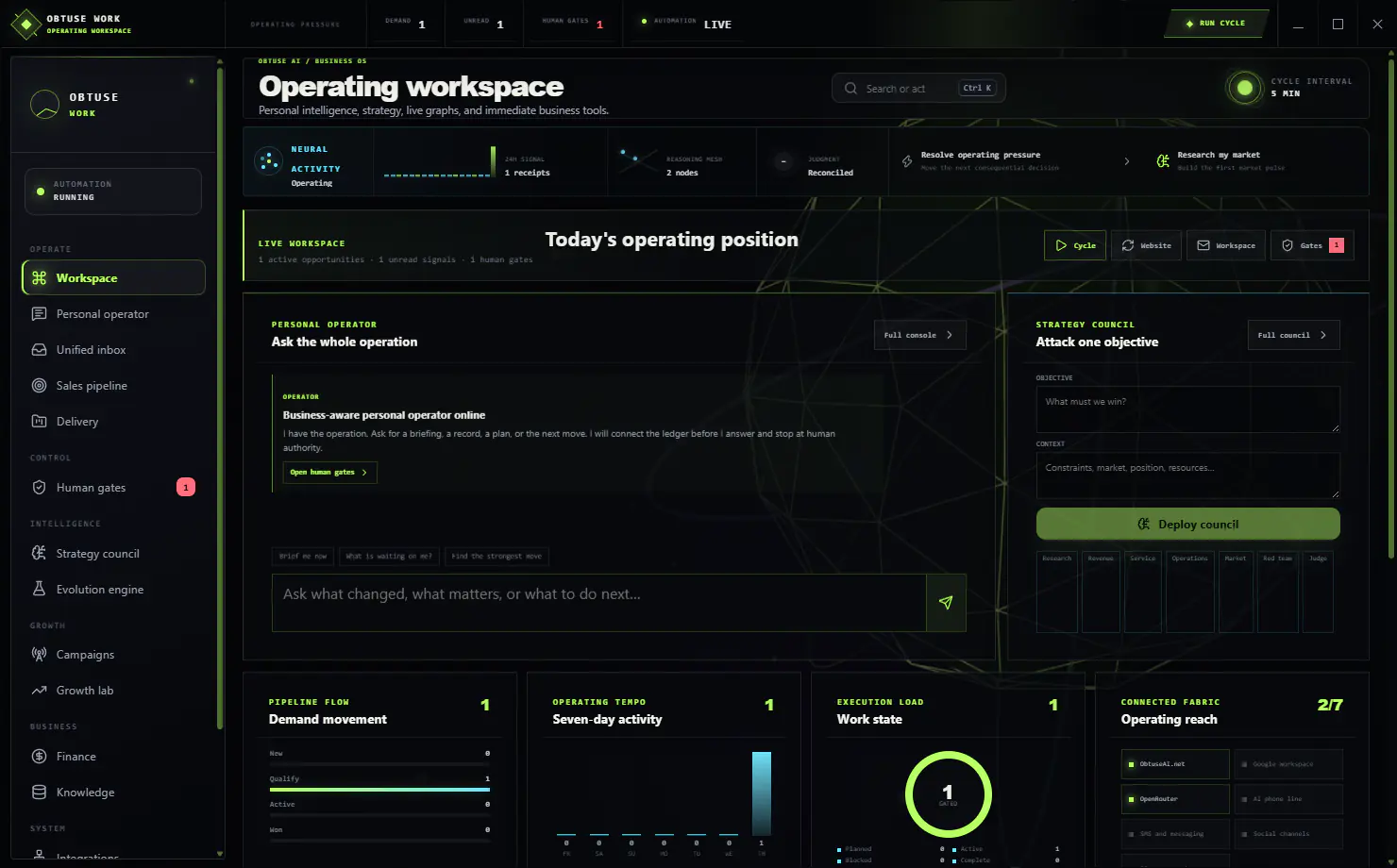
Our Windows desktop workspace gives a single operator one business-aware assistant across demand, sales, service, delivery, encrypted inbound communications, strategy, knowledge, growth, and governed improvement. The operating ledger stays local, the intelligence route is explicit, payments remain test-mode, and consequential moves stay behind visible human gates.
Personal intelligence, adversarial strategy, neural activity, operating graphs, approvals, and immediate tools converge in one readable cockpit.
Authority stays visible. Consequential actions stop at human gates until you approve them.
Open the contract, workflow, or capability you came to inspect.
Inspectable automation with explicit inputs, policy, human gates, and closure receipts.
BMobile companionEncrypted Android and iOS field capture with desktop review and no mobile execution authority.
COperating graphCRM, field service, projects, time, people, compliance, communications, and accounting on one record graph.
DCustomer fileOne customer record and one explainable queue from first contact through delivery.
EReviewed importsPreview every row, preserve the source, and commit deliberately.
FRevenue mathOne constraint, one measurable move, and a receipt at the end of every loop.
GPortability contractWhole-workspace export, encrypted recovery, and an exit that is a product feature.
HBrowser demoWalk the workspace in your browser before downloading anything.
Version 0.37 turns the operating workspace into a daily decision surface that opens the exact source record. Priority is derived from local state, timing, response targets, missing evidence, authority boundaries, ownership, and open financial value—not from an unexplained model score.
Decisions, business journeys, customer messages, delivery, appointments, receivables, and the current growth constraint enter one ranked operating queue instead of separate status cards.
Every item explains why it is present, which durable record proves it, and which source state must change before the item can clear.
Filter by operating lane, inspect with Arrow or J/K keys, and open the exact native work surface with one action. Gated journeys are deduplicated against their live approvals.
Prepare a polished client-review packet for an issued quote or invoice, share the file through the channel you choose, and bring the response back into the local record. Every consequential step stays tied to the exact document the client saw.
Each packet binds the issued document ID, version, number, type, currency, and integer total to a random challenge and a local SHA-256 artifact receipt.
The self-contained HTML packet makes no network request. The client can review the terms and download a bounded JSON response to return through the channel you choose.
Obtuse Work inspects the returned challenge, document identity, exact version, totals, and response hash before the operator confirms the record. Only an exact current issued quote can become accepted.
The response is evidence, not broad authority. A client response cannot create an invoice, collect payment, send a message, or approve a later document version.
Obtuse Work can turn an exact prepared quote or invoice packet into an opt-in one-time review link. Eight native contract cases establish the boundary, then ten device-bound live cases must prove the deployed host end to end before upload authority becomes eligible for the next 24 hours.
Obtuse Work encrypts the exact prepared packet on the Windows device with XChaCha20-Poly1305. The host receives ciphertext and opaque routing identifiers; the key and nonce stay in the browser-only URL fragment and are never sent to or stored by the host.
A named workstation receives its own current and previous credential pair in Windows Credential Manager while the host stores token hashes only. One opaque recipient is bound to one exact delivery and one-time access; rotation invalidates upload eligibility until the live suite passes again.
The live host is limited to ciphertext and minimal routing metadata with no review analytics or raw-IP retention. Explicit revoke and delete remove ciphertext immediately; expiry cleanup runs through the desktop cycle and opportunistic site maintenance, with content-addressed provider receipts.
Hosted delivery stays optional and operator-controlled. Every upload starts from a locally prepared, hash-verified packet and requires an explicit operator action plus a fresh successful live qualification. Link creation cannot issue a document, accept a quote, collect payment, or remove the offline path.
Turn a confirmed future appointment into a portable reminder artifact for email, SMS, or a manual handoff. The record preserves consent, timing, exact-version integrity, and what the operator later observed—without silently granting a transport provider authority.
Each reminder records the exact confirmed appointment version, selected channel, recipient, scheduled time, bounded message, and the operator-supplied basis for consent.
Obtuse Work prepares a human-readable text file and receipts both the message and the complete artifact with SHA-256 before the operator chooses an external channel.
Before retaining a provider receipt or direct observation, Work rehashes the managed artifact and confirms that the appointment is still confirmed at the exact bound version.
The reminder is a governed local record. Preparing or reconciling it cannot confirm, move, or cancel an appointment, and delivery is recorded only from a provider receipt or direct operator observation.
A qualified adapter can deliver strict inbound voice, SMS, and web events through a ciphertext-only queue. Work verifies and decrypts them on the Windows device, reconciles each identity once, exposes recent local queue health, and lets the operator pause any qualified channel without granting the host access to contact content.
A bounded adapter encrypts each strict normalized event with XChaCha20-Poly1305 and signs the exact envelope. The hosted queue receives ciphertext and routing metadata, never the end-to-end root or contact content.
Work verifies the provider receipt, original-body SHA-256, exact HMAC, credential generation, replay window, adapter and channel scope, ciphertext hash, and authenticated decryption before interpreting the event.
A valid event or bounded quarantine receipt is durable locally before acknowledgement clears the raw encrypted envelope. Routine replies remain local drafts; opt-out, failure, transfer, and consequential language preserve human ownership.
Pause voice, SMS, or web intake independently from Communications Bay. Verified events on a paused channel become durable quarantine receipts without creating sessions, while recent imported, quarantined, acknowledged, and pending counts keep queue posture visible.
Inbound transport is real; outbound authority is not. The generic edge creates no carrier account or phone number, streams no audio, records nothing, sends no message, calls no model, confirms no appointment, and makes no commercial commitment.
The same fixed suite measures the deterministic router before each expansion. Closed simulation cleanup then requires an exact preview, an exact challenge, and an unchanged row-set hash; imported provider transcripts are excluded from that simulation-only control.
Eight unchanged cases compare expected and observed status, specialist, and intent across opt-out, safety, consequential requests, scheduling, account status, service, qualification, and word-boundary behavior.
A cleanup preview binds the exact cutoff, closed-session count, transcript-turn count, date range, complete row-set SHA-256, short-lived challenge, and expiry before anything can be removed.
Execution re-reads and re-hashes the exact rows inside one transaction. Imported provider transcripts, active sessions, consent-waiting sessions, and human handoffs stay protected while the receipt retains only cutoff, counts, and integrity hash.
Router qualification does not create authority. The suite, previews, challenges, and receipts stay local; encrypted inbound events still cannot create a carrier account, recording, external send, or consequential commitment.
One strict manifest proves the normalized adapter contract before the operator provisions its encrypted inbound path. The generic reference adapter can submit that event without adding provider-specific code to the desktop; provider webhook validation remains inside the bounded upstream translator.
A provider-neutral JSON contract is capped at 64 KB, rejects unknown fields, bounds channel scope, and names only an operating-system vault slot. It carries no credential value or executable code.
The same native suite checks stable identity, credential isolation, HMAC-SHA256 positive and tampered-body behavior, replay freshness, distinct consent and outcome events, integer-micro cost ceilings, and confirmed human transfer.
Exact current 8/8 is required before the operator can provision or rotate that adapter's encrypted inbound edge. Regressions remain visible, and every requalification run stays in exportable history.
Provisioning grants one narrow capability. A qualified adapter can deliver authenticated encrypted inbound events; it cannot open a desktop listener, reach a carrier on its own, record audio, or send a message.
Version 0.37 retains the narrow, loopback-only signal rail introduced in 0.29 for scripts, utilities, and companion tools running on the same Windows machine. A reference connector shows the complete workflow; every accepted signal stops in a separate review inbox until a person decides what it means.
Local tools submit strict JSON signals to one fixed loopback endpoint. No public listener, browser access, cross-origin surface, executable payload, or provider-specific desktop code is introduced.
The operator chooses the permitted signal kinds and receives each token once. Work stores only token hashes, retains one short rotation overlap, rate-limits new signals, and rejects stale, oversized, or shape-changing replays.
Accepted signals enter a separate review-only inbox where they can be inspected, marked reviewed, or dismissed. They cannot promote themselves into work, invoke a model, send a message, schedule anything, or move money.
An integration can inform Work; it cannot operate Work. Provisioning, rotation, review, dismissal, and revocation stay local and operator-owned. No connector token grants code execution, automatic promotion, external communication, scheduling authority, model access, or payment authority.
One selected route now powers intake, the Personal Operator, Market Pulse, Strategy Council, and governed evaluation. Routes never switch behind the operator’s back.
Use OpenRouter with data-collection denial, provider price filters, structured response repair, and bounded search when current external evidence is required.
Run through local Ollama on loopback only. Model calls stay on the Windows machine while the same schemas, cost ledger, quarantine rules, and human gates remain in force.
Connect a direct OpenAI-compatible HTTPS endpoint with an isolated vault key, explicit privacy confirmation, and declared token rates for meaningful cost receipts.
Version 0.37 retains the shared-device operating environment for up to five people. Identity, role, command enforcement, lock state, and access evidence are part of the native application—not a visual convention.
Activate a local workspace with an administrator, then add up to four more people. Each person unlocks with a separate passphrase; restart and explicit lock return Work to the identity gate.
Administrators manage people and the complete workspace. Members can run day-to-day work. Viewers can inspect the operation without changing it.
Every human-invoked native command checks the active member and required capability in Rust before data is returned or changed. A hidden button is never the security boundary.
Successful, failed, interrupted, and denied changes leave access receipts tied to the named member and command. Locked screens conceal identities and access history until someone unlocks.
Shared-device authority is the foundation. Each named person has an inspectable local boundary today; multi-device synchronization and remote team administration remain separate future capabilities.
No command maze. No mystery autonomy. Every move has a job, a visible state, and a clear owner.
Bring demand, Workspace, customer work, and operating signals into one governed environment.
See pressure, opportunities, commitments, neural activity, and exceptions without hunting through disconnected tools.
Deploy current research, independent specialists, an adversarial red team, and a separate judge against the pressure.
Approve, edit, schedule, assign, synchronize, or stop an action from one explicit control surface.
Research the market, challenge the playbook, measure alternatives, promote deliberately, and keep rollback within reach.
This is not another dashboard dropped on top of the mess. It is a source-aware operating memory, an embedded personal operator, an adversarial strategy layer, an autonomous market-intelligence cycle, and one place where intelligence creates momentum without quietly taking authority.
Ownership is implemented in the private-pilot build: complete export, guarded recovery, local backups, and an open signed event rail.
Every durable application table is written to portable JSON and a matching CSV, alongside a recovery database.
Create one password-encrypted .obtuse-work file for protected off-device storage or manual transfer to another Windows computer without writing a plaintext temporary database.
Imports are schema-verified, the current workspace receives a safety copy, and replacement requires explicit confirmation.
Connector secrets stay in Windows Credential Manager, and readable JSON/CSV exports redact derived Team Authority credential hashes. Full-fidelity recovery retains the protected local access state.
Download the public Windows preview, or scope a private pilot around the workflow creating the most drag. The installer is not yet code-signed; verify the published SHA-256 before running.
Preview installer SHA-256 (v0.37.0): A7BFAE17D8D0CAC47B2984635BDC1BB8BED17C5C626AC496E0C57CB357A4F058
Prefer the stable release? Download v0.35.0 · SHA-256: 14AEA8239A683E6ECB3032E869F52C527BE23F937A575C6F94662B64D416521C
Release status — Windows v0.35.0: stable release · Windows v0.37.0: public preview · Android 0.36.0: debug-signed qualification build · iOS: source complete, not yet distributed · Not shipped: live payment rails, carrier telephony, concurrent multi-device collaboration, extension marketplace.
When general pricing launches it will be ownership-first: a license you buy once and keep, with updates and support as optional add-ons — never per-seat rent. Guided founding pilots start at $2,500.